
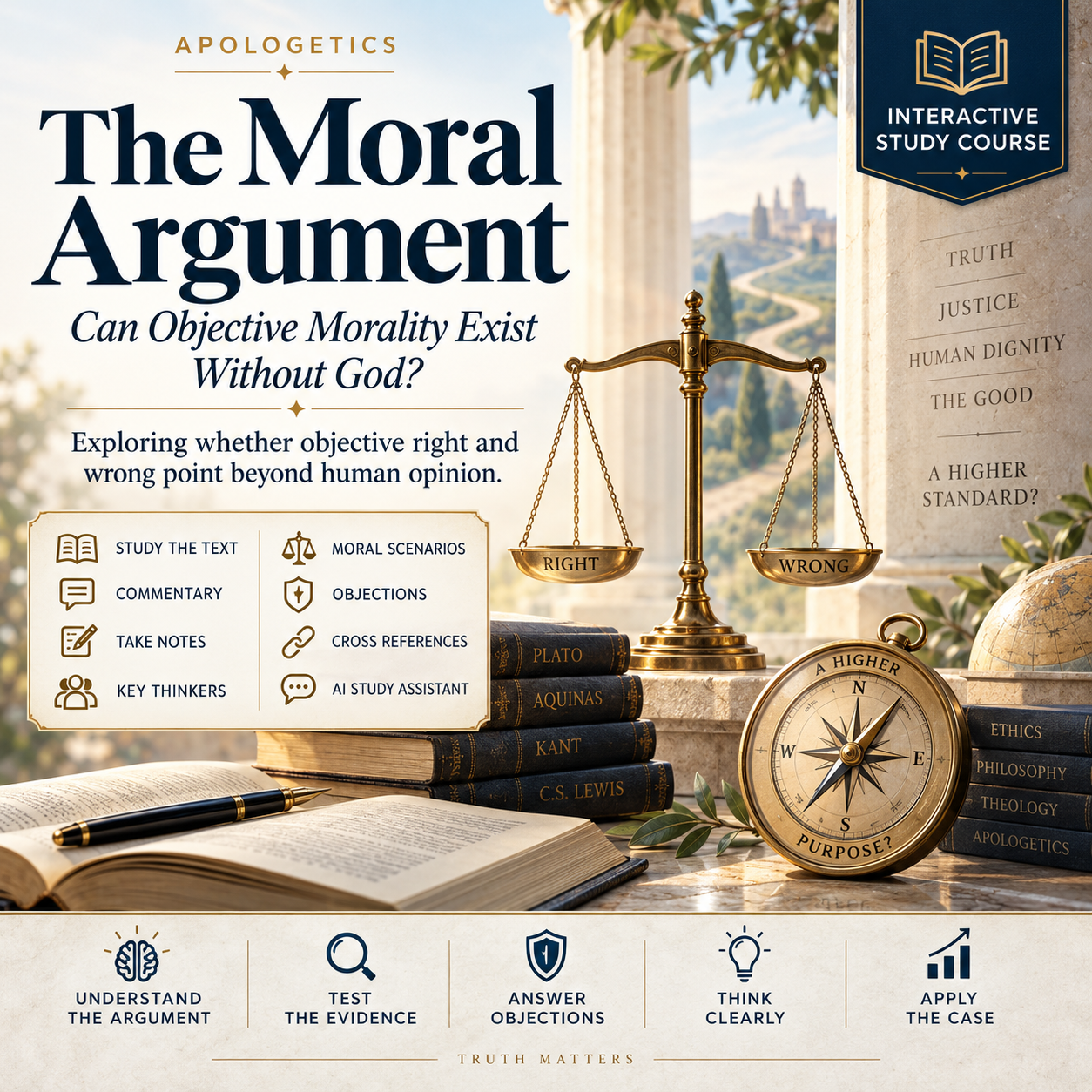
Lesson 4: The Moral Argument: Can Objective Morality Exist Without God?
Original price was: £12.99.£9.99Current price is: £9.99.
The Moral Argument is a practical apologetics course exploring whether objective moral values and duties can exist without God. Examine the difference between moral opinion and moral truth, consider major secular explanations of morality, and explore the case for grounding goodness, justice and obligation in the character of God
This is a digital product; nothing is shipped. Access is provided electronically after successful payment, as described on this page. By requesting immediate access, you acknowledge that your cancellation rights may be affected once digital supply begins. This does not affect your rights if content is faulty, misdescribed, or inaccessible. Refunds & Cancellations.
Arguments for God
This is lesson 4 of Arguments for God. Get access to every lesson in the course with the full course bundle.
An interactive lesson in 15 sections
Each lesson takes you from the biblical text through commentary, reflection, and personal application — structured across 15 interactive sections.
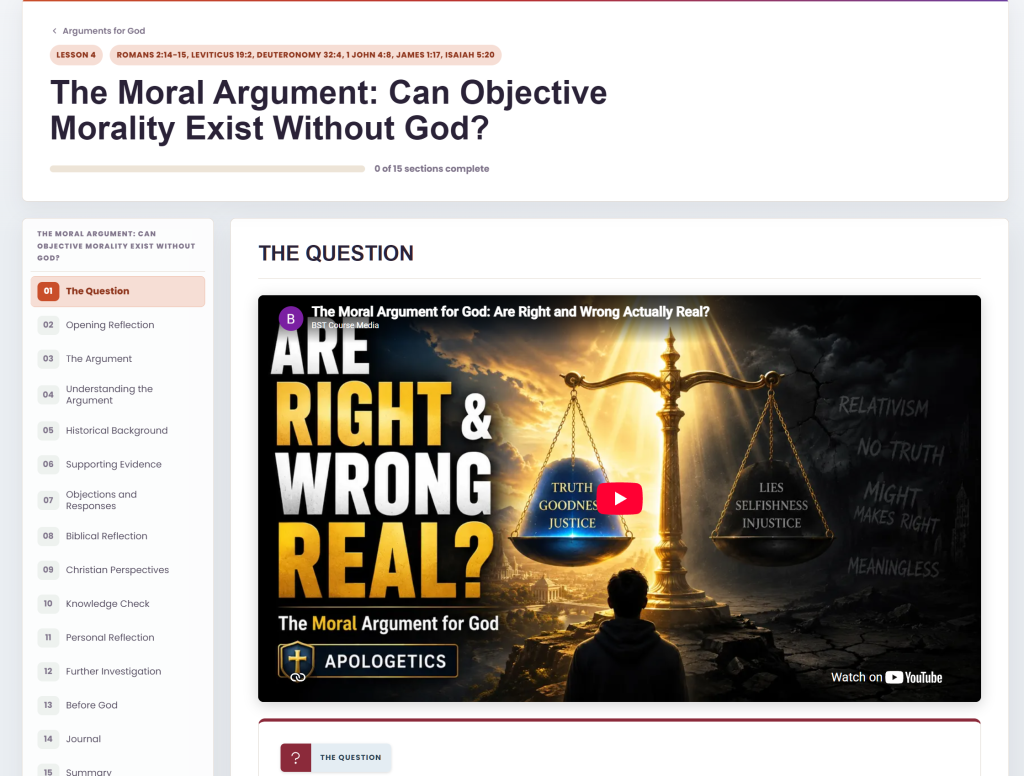
- The Question
- Opening Reflection
- The Argument
- Understanding the Argument
- Historical Background
- Supporting Evidence
- Objections and Responses
- Biblical Reflection
- Christian Perspectives
- Knowledge Check
- Personal Reflection
- Further Investigation
- Before God
- Journal
- Summary
Description
The Moral Argument: Can Objective Morality Exist Without God? explores one of the most personal and widely discussed arguments for God’s existence: the claim that objective moral values and duties require a transcendent foundation. Most of us instinctively speak as though some things are genuinely right or wrong. Cruelty, injustice and exploitation do not seem merely unpopular or socially inconvenient; we treat them as things that ought not to happen, regardless of whether a particular person or culture approves of them. This course asks what that moral experience actually tells us about reality.
You will examine the classic form of the Moral Argument, explore the distinction between moral values and moral duties, and consider why an impersonal, purely material universe may struggle to account for genuine moral obligation. The course also introduces important concepts such as the is–ought problem, moral ontology, moral epistemology and the relationship between conscience and objective moral truth. Rather than ignoring alternative explanations, the course engages directly with some of the strongest objections. You will consider evolutionary accounts of morality, social contract theory and the Euthyphro Dilemma, asking whether these approaches successfully explain why human beings experience moral duties as genuinely binding. The course also traces the development of the argument through thinkers such as Plato, Thomas Aquinas, Immanuel Kant, C. S. Lewis, John Henry Newman, Francis Schaeffer and Robert Merrihew Adams, showing how different Christian traditions have approached the relationship between God, goodness, conscience and moral obligation. Alongside the philosophical material, the course explores key biblical passages including Romans 2:14–15, Leviticus 19:2, Deuteronomy 32:4, 1 John 4:8, James 1:17 and Isaiah 5:20. These passages help connect the philosophical case for objective morality with the Christian claim that goodness is ultimately grounded not in arbitrary rules, but in the unchanging character of God Himself. Through guided teaching, worked examples, objections and responses, activities, knowledge checks and personal reflection, the course is designed to help you understand the argument clearly and communicate it thoughtfully. The aim is not simply to memorise a proof, but to become better equipped to discuss questions of morality, justice, human dignity and belief in God with confidence, clarity, gentleness and respect.
No previous knowledge of philosophy is required. The course is suitable for anyone wanting to understand the Moral Argument more deeply, strengthen their apologetics, and think more carefully about whether objective morality ultimately points beyond humanity to a transcendent moral foundation.
Themes covered in this study:
Explore more on this theme: Browse all →
Lesson 3: Kalam Cosmological Argument
Related products
-
Sale!

Lesson 3: Kalam Cosmological Argument
Original price was: £12.99.£9.99Current price is: £9.99. -
Sale!
Lesson 3: Daniel’s Seventy Weeks: Understanding the Prophecy
Original price was: £12.99.£9.99Current price is: £9.99. -
Sale!
-



Reviews
There are no reviews yet.