
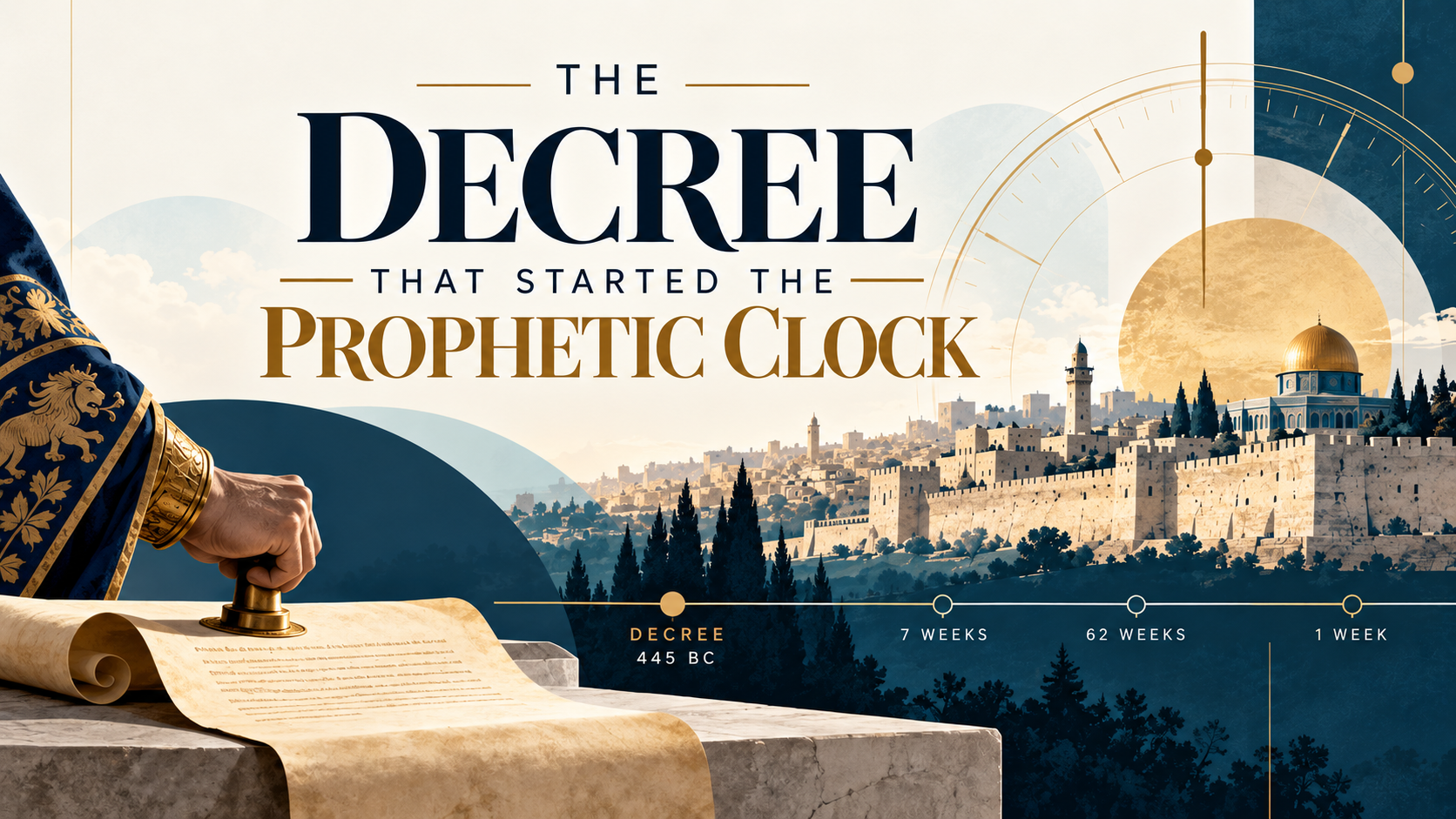
When reading the book of Daniel, the timeline of the seventy weeks can be difficult to understand. Many find themselves unsure whether the prophetic clock has paused or continues to tick without interruption. This confusion is common when approaching Daniel 9:20 to 27, one of the most densely packed and heavily debated prophetic passages in Scripture.
The passage marks a pivotal shift in the book. Gabriel descends to decode a timeline that reaches far beyond the Babylonian exile into the very heart of God’s eternal plan. Gabriel’s arrival answers Daniel’s prayer, bridging the gap between the historical seventy years of desolation and the seventy sevens of future redemption. But how exactly does this timeline work, and is there a gap before the final week? To answer this, we must trace the chronological markers that define the beginning and key divisions of the seventy-week timeline.
Understanding the Chronological Markers
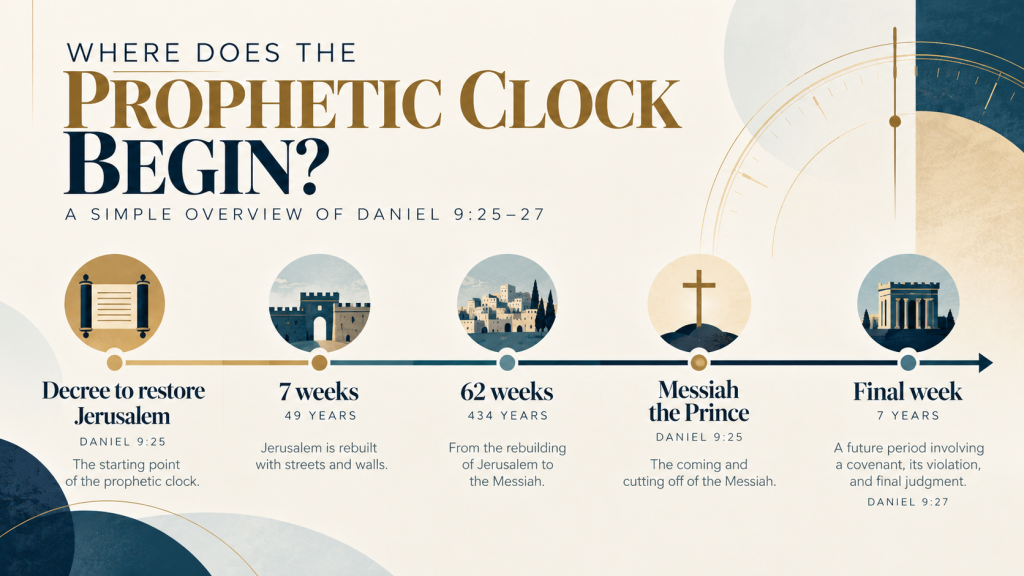
Know therefore and understand, that from the going forth of the commandment to restore and to build Jerusalem unto the Messiah the Prince shall be seven weeks, and threescore and two weeks: the street shall be built again, and the wall, even in troublous times. Daniel 9:25
Before addressing the structural debate, we must first slow down and grasp the passage as a unified whole. Gabriel reveals a seventy-week timeline, or seventy sevens, that outlines the decreed purposes for God’s people. Verse 24 lists six specific spiritual purposes decreed for these seventy weeks, shifting the focus from historical restoration to ultimate spiritual reconciliation.
- to finish transgression
- to make an end of sins
- to make reconciliation for iniquity
- to bring in everlasting righteousness
- to seal up vision and prophecy
- to anoint the most holy
The prophecy begins with a specific trigger: the going forth of the commandment to restore and build Jerusalem. From this starting point, verse 25 divides the first sixty-nine weeks into two distinct blocks. There are seven weeks, followed by sixty-two weeks. Most interpreters agree that the initial seven weeks, representing forty-nine years, correspond to the era of the physical and civic restoration of Jerusalem under Ezra and Nehemiah. The text notes that the street and moat shall be built again even in troublous times, reflecting the intense opposition from surrounding nations during this historical restoration. The subsequent sixty-two weeks, or 434 years, represent the long intertestamental period of waiting. During this era, the city stood rebuilt, but the ultimate Messianic redemption had not yet arrived. This division shows that God’s promises are fulfilled in stages. We first see the difficult historical restoration of the physical city, followed by a long period of anticipation that culminates in the arrival of the Anointed One.
What does Daniel 9:25 actually say?
A few details are worth noting before we start reaching for dates. First, Gabriel speaks about Jerusalem, not simply the temple. Rebuilding Jerusalem involved more than restoring the sanctuary. A functioning city needed streets, walls, gates, homes, administration and some form of civic life. Then there is the phrase “the commandment”. The Hebrew word is dabar, a very ordinary word meaning something like word, message or matter. It does not necessarily mean a technical Persian royal decree. Keep that in mind, because it becomes interesting later. And finally, Gabriel says that Jerusalem will be rebuilt “in troublous times.” That certainly fits what we find in Ezra and Nehemiah. The restoration happened, but it was anything but straightforward. So which “word” starts the clock? There are four main possibilities.
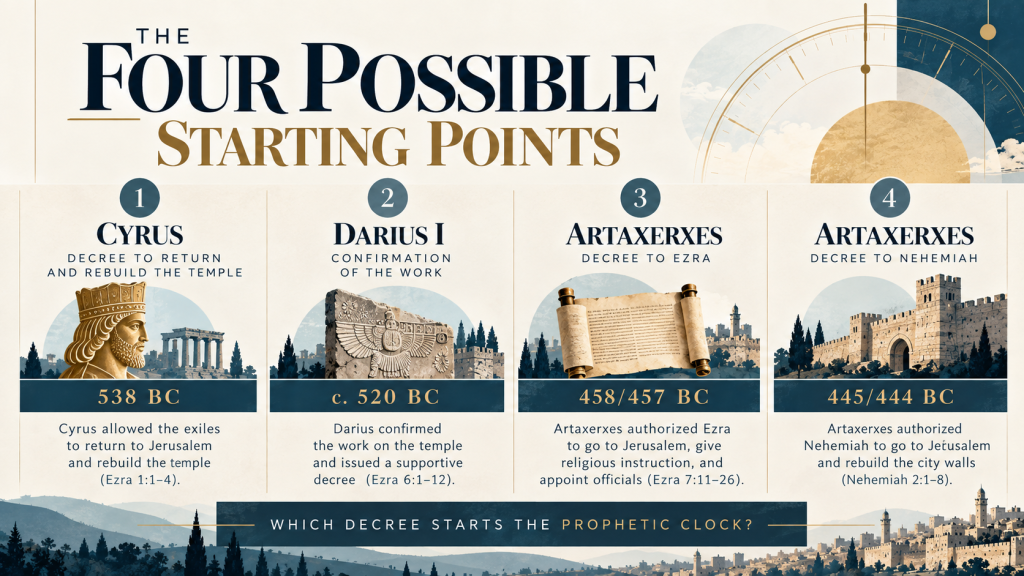
1. Cyrus — 538 BC
The obvious place to begin is Cyrus. Cyrus conquered Babylon in 539 BC and soon afterwards allowed the Jewish exiles to return home and rebuild the house of the LORD. We read about this in Ezra 1:1–4. After decades in exile, this must have been extraordinary news. Jerusalem had been destroyed, the temple was gone, and many of the people had spent most or all of their lives in Babylon. Now they were being told they could go home. At first glance, though, Cyrus’s decree seems to focus mainly on the temple, rather than the restoration of Jerusalem as a complete city. But Isaiah makes things more interesting. Speaking prophetically about Cyrus, God says in Isaiah 44:28:
He shall say to Jerusalem, Thou shalt be built; and to the temple, Thy foundation shall be laid.
Isaiah 45:13 also says of Cyrus:
he shall build my city, and he shall let go my captives.
So Cyrus cannot simply be dismissed. Ezra concentrates on the temple, while Isaiah speaks of Cyrus in connection with Jerusalem itself. The problem comes when we start counting. If we begin around 538 BC and add 483 years, we arrive somewhere around 55 BC. That does not bring us anywhere near Jesus’ ministry. For that reason, interpreters who begin with Cyrus usually have to read the seventy weeks less strictly chronologically, or connect the prophecy to a different historical fulfilment. So Cyrus fits some of the wording very well. He fits the 483-year calculation much less comfortably.
2. Darius I — around 520 BC
About twenty years later, we come to Darius I. By this point, the rebuilding work had stalled. Local officials questioned whether the Jews really had permission to continue, so the matter was referred to Darius. A search was made of the royal archives; Cyrus’s decree was found, and Darius confirmed it. He even ordered that the work should be financially supported and warned local officials not to interfere. You can read the story in Ezra 6:1–12. Very few interpreters begin Daniel’s seventy weeks with Darius, and it is not difficult to see why. Darius is not really issuing a completely new command to restore Jerusalem. He is confirming what Cyrus had already authorised, and the immediate issue is still the temple. But Darius does show us something useful. These Persian decrees were not four unrelated events. One king could issue an order, another could confirm it, and later permissions could expand what had already begun. The restoration of Jerusalem unfolded in stages. That becomes important when we reach Artaxerxes.
3. Artaxerxes and Ezra — 458/457 BC
Now things become particularly interesting. In the seventh year of Artaxerxes I, Ezra is sent to Jerusalem with a royal letter. You can read it in Ezra 7:11–26. Ezra is given silver and gold for the temple, but his authority goes further than overseeing worship. He is allowed to appoint magistrates and judges, teach the Law of God and enforce it. That sounds much more like the restoration of a functioning society. Jerusalem is not merely being given permission to build something. The Jewish community is being given the ability to organise and govern its affairs under Persian authority. There is an obvious objection: Ezra 7 never specifically says, “Go and rebuild the walls.” But earlier in Ezra we find something interesting. In Ezra 4, opponents of the Jews write to Artaxerxes complaining that:
the Jews which came up from thee to us are come unto Jerusalem, building the rebellious and the bad city, and have set up the walls thereof…
So during the reign of Artaxerxes, Jerusalem was already being rebuilt as a city, including work on its walls, before Nehemiah arrived. And this is where the dates become interesting. If we take 457 BC as our starting point and count forward 483 years, remembering that there is no year zero between 1 BC and AD 1, we arrive at approximately AD 27. That puts us in the period when John the Baptist began his ministry, and Jesus was baptised. And what happens at Jesus’s baptism? The Holy Spirit descends upon Him. In other words, Jesus is publicly anointed. That makes this interpretation attractive to many Christians.
Daniel says the sixty-nine weeks lead to an “anointed one”, and the 457 BC starting point brings the calculation remarkably close to the beginning of Jesus’s public ministry. It is especially attractive to interpreters who understand the seventy weeks as one continuous chronological period.
4. Artaxerxes and Nehemiah — 445/444 BC
This is getting interesting, right? We now come to Nehemiah. This is probably the event most people immediately think of when they hear the phrase “rebuild Jerusalem.” Nehemiah is cupbearer to King Artaxerxes. The king notices that he looks miserable and asks what is wrong. Nehemiah explains that Jerusalem, the city of his ancestors, is still in ruins. Then he asks in Nehemiah 2:5:
send me unto Judah, unto the city of my fathers’ sepulchres, that I may build it.
Artaxerxes agrees. Nehemiah is given letters guaranteeing safe passage and permission to obtain timber for the gates and walls. When he arrives in Jerusalem, the rebuilding begins in earnest. And it certainly happens in “troublous times.” The builders face threats, mockery and intimidation. At one point they are working while armed, ready to defend themselves if attacked. Eventually the wall is completed in just fifty-two days. So if we were simply asking which event sounds most like: “the street shall be built again, and the wall, even in troublous times” Nehemiah would be an extremely strong candidate. There is just one problem. The dates.
If we begin around 445 BC and count 483 ordinary solar years, we arrive around AD 39. That is too late to fit the ministry and death of Jesus. This led Sir Robert Anderson, writing in The Coming Prince in 1894, to suggest another approach. Anderson argued that the prophecy should be calculated using a 360-day prophetic year rather than an ordinary solar year. One reason given for this comes from Revelation, where 42 months and 1,260 days appear to describe the same period. If a month is treated as 30 days, twelve months gives a 360-day year. Using that system, 483 prophetic years becomes 173,880 days.
Anderson calculated that those days stretched from Artaxerxes’ decree to Nehemiah all the way to Jesus’s triumphal entry into Jerusalem. Later, Harold Hoehner revised some of Anderson’s dates and argued for a period running from 444 BC to AD 33. It is an impressive calculation. But it is also debated. The obvious question is whether Daniel himself gives us a reason to convert the years into 360-day periods, or whether that calendar is being introduced because it allows the chronology to reach the desired date. That does not automatically make the interpretation wrong. But it is something we should be honest about.
Both major approaches involve choices: which decree to use, which calendar to follow, and which event in the life of Jesus marks the arrival of “Messiah the Prince”.
The little detail that can easily be missed
There is another possibility hiding just two verses earlier. And I think it is one of the most interesting details in the whole passage. In Daniel 9:23 Gabriel tells Daniel:
At the beginning of thy supplications the commandment came forth…
That phrase, a word or dabar going out, is very similar to the language used in verse 25:
from the going forth of the commandment…
But in verse 23, the “word” clearly is not coming from Cyrus, Darius or Artaxerxes. It is coming from God. Gabriel is telling Daniel that the moment Daniel began to pray, a word went out from heaven. So when very similar language appears two verses later, it raises an interesting question. What if the prophecy is not asking us only to look for the day a Persian king signed a document? What if the word goes out from God first, and the Persian decree is the historical means through which that divine purpose begins to be carried out? There may even be a connection with Jeremiah. Remember what Daniel had been doing at the beginning of the chapter. He had been reading Jeremiah’s prophecy concerning the seventy years of Jerusalem’s desolation. Jeremiah had already written in Jeremiah 30:18:
the city shall be builded upon her own heap
That doesn’t give us a neat date to plug into a calculator. But it reminds us of something important. Behind the decrees of Persia stands the decree of God. Cyrus, Darius, and Artaxerxes may issue royal commands, but ultimately they carry out what God had already determined.
So which starting date is right?
The four main possibilities can be summarised simply:
| Starting point | Date | Main Passage | Main Emphasis |
|---|---|---|---|
| Cyrus | 538 BC | Ezra 1:1–4; Isaiah 44:28 | Temple in Ezra; Jerusalem in Isaiah |
| Darius I | c. 520 BC | Ezra 6:1–12 | Confirms Cyrus’s decree |
| Artaxerxes – Ezra | 458/457 BC | Ezra 7:11–26 | Restoration of Jewish civil and religious life |
| Artaxerxes – Nehemiah | 445/444 BC | Nehemiah 2:1–8 | Jerusalem’s walls and gates |
For Christians who expect the sixty-nine weeks to lead directly to Jesus, the discussion usually comes down to the two decrees of Artaxerxes. And underneath that are two larger questions. What event marks the arrival of “Messiah the Prince”? Is it Jesus’s baptism and the beginning of His public ministry? Or is it His triumphal entry into Jerusalem shortly before His crucifixion? And then there is the question of the calendar. Should we use ordinary years? Or should Daniel’s “years” be calculated as 360-day prophetic years? Those decisions make a very big difference to where the sixty-nine weeks land.
And this is where the gap question enters
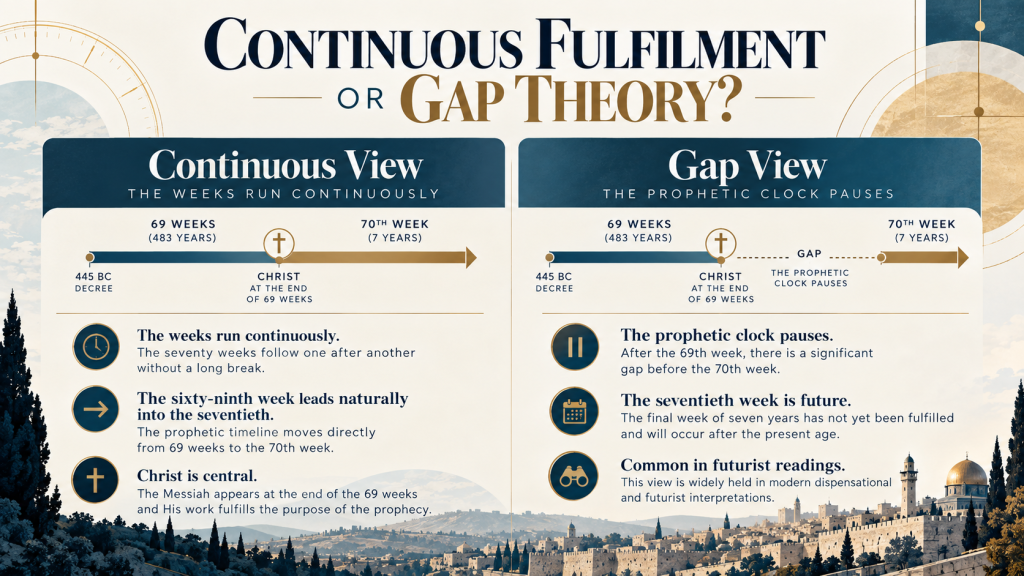
Choosing the starting point does not just affect the first sixty-nine weeks. It often influences how the rest of the prophecy is understood. Those who begin around 457 BC and follow the chronology continuously tend to understand the seventieth week as following naturally after the sixty-ninth. In that reading, the prophecy reaches the ministry and death of Christ without inserting an indefinite pause into the seventy weeks. Those who begin with Nehemiah and connect the sixty-nine weeks with Christ’s triumphal entry are often more open to a gap between the sixty-ninth and seventieth week. In that framework, the final week remains future.
This is why debates over Daniel 9 are not really just debates over arithmetic. The starting point shapes the endpoint, and the endpoint shapes how we read the final week. That leads directly into another major question: Who is the “he” in Daniel 9:27 who confirms the covenant? Is Daniel still speaking about Christ? Or has the prophecy moved forward to a future ruler? That deserves its own discussion.
Why the debate matters, and why it should not dominate the passage
It is easy to become so absorbed in the dates that we miss what Daniel 9 is actually doing. Faithful interpreters disagree because they are trying to take the details seriously. The debate touches chronology, the Messiah’s atoning work, Jesus’s warnings about the abomination of desolation, the relationship between Israel and the Church, and whether the final week has already unfolded or remains in the future. Those questions matter. But they are not the only thing the passage says. Daniel begins the chapter grieving over sin and Jerusalem’s desolation. Gabriel’s answer eventually reaches far beyond a rebuilt wall. It speaks of making reconciliation for iniquity, bringing in everlasting righteousness, the coming of the Anointed One, His being cut off, and the certainty that even desolation has limits fixed by God. The prophecy is therefore both historical and theological. It gives us dates and markers, but it also tells us where history is going.
Before any Persian king picked up a pen

After all the dates, decrees and calculations, there is something in Daniel 9 that I think is even more important. Daniel begins this chapter praying. Jerusalem is in ruins. His people have been in exile. From Daniel’s point of view, very little seems to be happening. But Gabriel tells him that the moment he began to pray, the word went out. Before Cyrus issued a decree… before Darius searched the archives… before Ezra returned to Jerusalem… and before Nehemiah stood in front of Artaxerxes asking permission to rebuild the walls… God was already at work. The Persian paperwork came later. God’s purpose came first.
And perhaps that is one of the biggest things Daniel 9 wants us to see. The seventy weeks are not simply a complicated biblical puzzle where God expects us to produce the correct answer with a calculator. They show us a God who is sovereign over real history. Kings rise and fall. Empires change. Jerusalem is destroyed and rebuilt. Decrees are issued, challenged, confirmed and carried out. Yet through all of it, God is moving history towards the promised Messiah and towards His purpose of dealing with sin. The dates are fascinating. But the God who stands behind them is the real point.
If you want to trace these chronological markers and understand the profound spiritual purposes decreed for the seventy weeks, we invite you to explore our comprehensive study materials. You can find our complete course, Daniel’s 70 Weeks: Understanding the Prophecy, on Bible Study Themes. This resource is designed to help church study leaders, small groups, and serious individual readers build a solid foundation in this pivotal prophetic text. Visit the study material on Bible Study Themes today to start the course and navigate the timeline of Daniel with confidence.

One Comment