
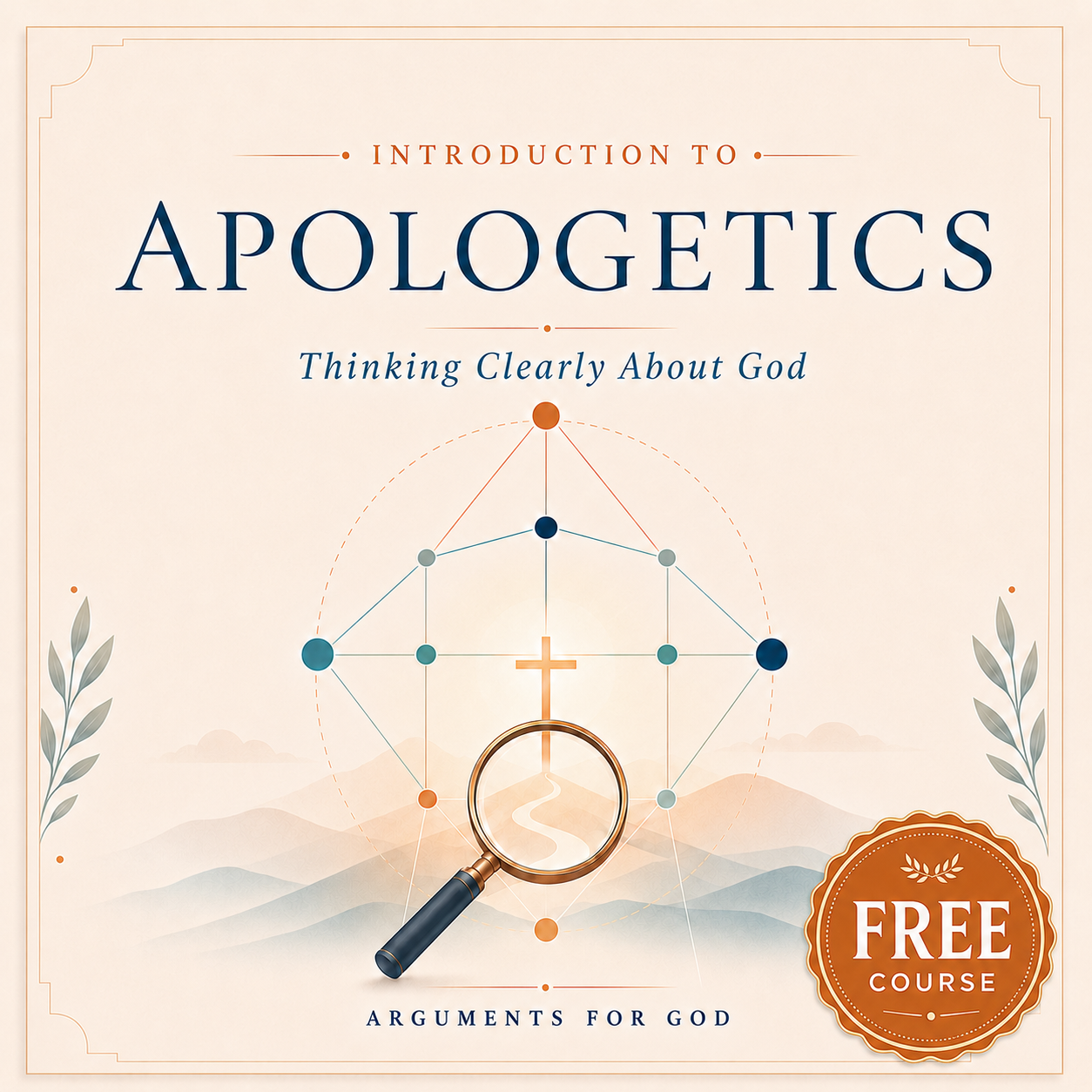
Lesson 1: Introduction to Apologetics: Thinking Clearly About God
This is a free preview lesson — no payment is needed. Create a free account to access it.
Get Free Access →Introduction to Apologetics is a free study course designed to help Christians think more critically about faith, reason and arguments for God. Learn how philosophical arguments for the existence of a creator are formed, how to distinguish strong reasoning from weak reasoning, and how to respond to questions about Christian belief with greater clarity, confidence, gentleness and respect, as per 1 Peter 3:15.
Arguments for God
This is lesson 1 of Arguments for God. Get access to every lesson in the course with the full course bundle.
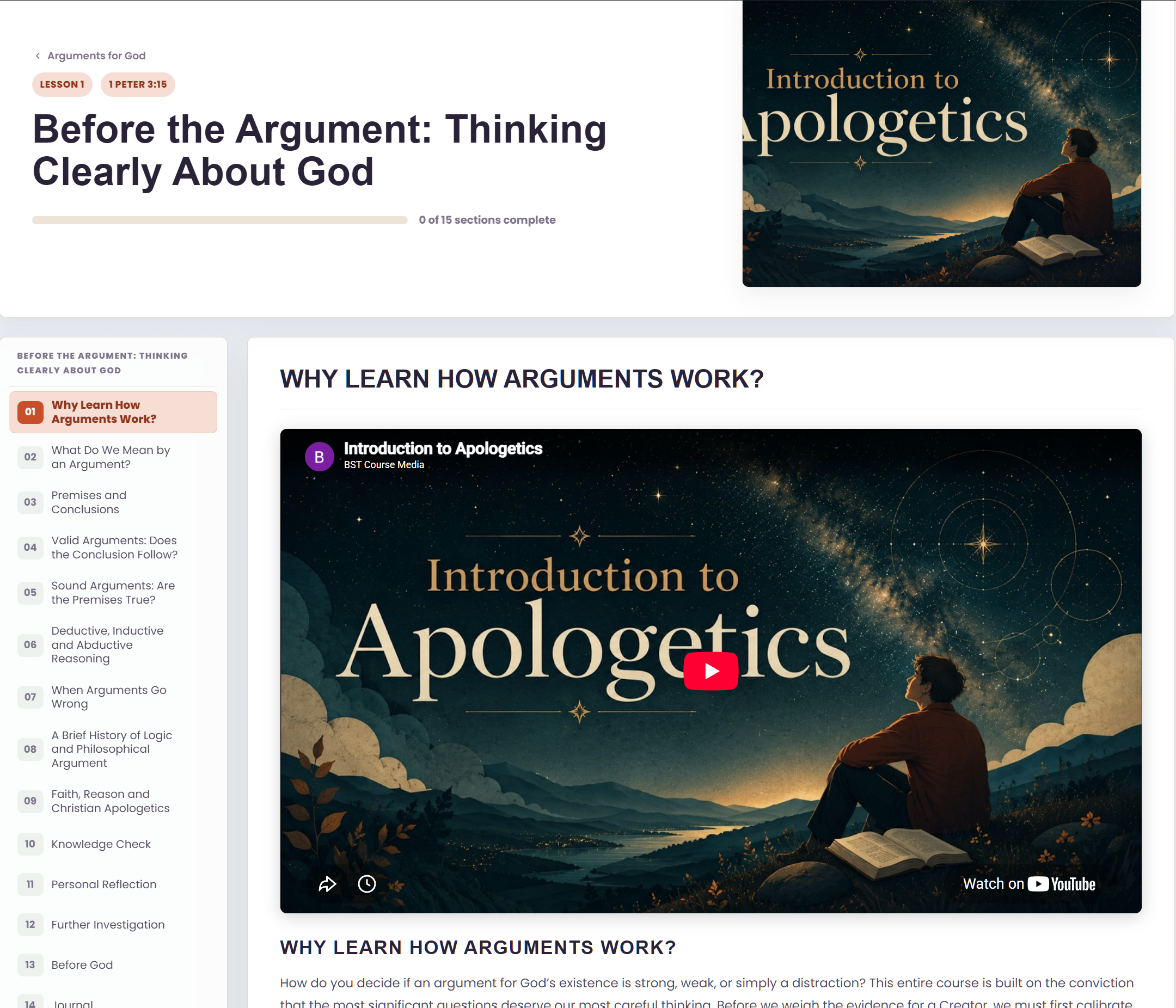
An interactive lesson in 15 sections
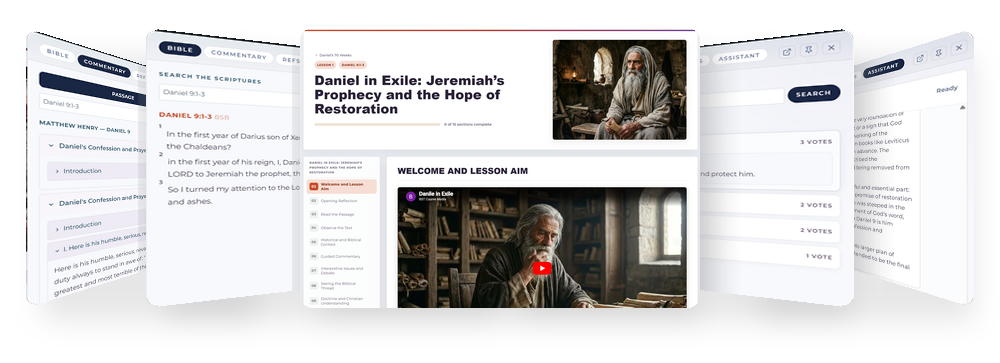
Each lesson takes you from the biblical text through commentary, reflection, and personal application — structured across 15 interactive sections.
- Why Learn How Arguments Work?
- What Do We Mean by an Argument?
- Premises and Conclusions
- Valid Arguments: Does the Conclusion Follow?
- Sound Arguments: Are the Premises True?
- Deductive, Inductive and Abductive Reasoning
- When Arguments Go Wrong
- A Brief History of Logic and Philosophical Argument
- Faith, Reason and Christian Apologetics
- Knowledge Check
- Personal Reflection
- Further Investigation
- Before God
- Journal
- Summary
Description
Introduction to Apologetics
Introduction to Apologetics is a practical course for Christians who want to think more clearly about their faith and become better equipped to examine arguments about God.
Before we can decide whether an argument for God’s existence is convincing, we first need to understand how arguments work. What is the difference between an argument and a simple assertion? How do premises support a conclusion? What makes an argument valid, and what makes it sound? These questions provide the foundation for everything that follows.
The course introduces the essential tools of logical reasoning in a way that is clear and approachable. You will learn how to identify premises and conclusions, examine whether a conclusion genuinely follows from the evidence, and recognise when an argument is built upon false or unsupported assumptions.
You will also explore deductive, inductive and abductive reasoning, including the important difference between proving a conclusion, showing that it is probable, and arguing that it offers the best explanation of the available evidence. Common errors in reasoning are considered as well, including circular reasoning, strawman arguments and false dilemmas.
Alongside these practical skills, the course considers the place of reason within the Christian faith. Apologetics is not about winning arguments or attempting to pressure someone into belief. It is about giving thoughtful reasons for what we believe, examining objections honestly, and speaking with the gentleness and respect described in 1 Peter 3:15.
You will also be introduced to some of the major thinkers who have shaped the history of logic and Christian argument, including Aristotle, Thomas Aquinas, Gottlob Frege and C. S. Lewis. Their work helps show that careful reasoning has played an important role in both philosophy and Christian thought.
Through guided teaching, examples, activities, knowledge checks and personal reflection, this course will help you develop a reliable framework for assessing arguments and truth claims. It provides a foundation for studying the major philosophical arguments for God’s existence while also offering skills that can be applied to conversations, articles, books and claims encountered in everyday life.
No previous knowledge of philosophy or logic is required. The course is intended for anyone who wants to understand apologetics, examine Christian belief more thoughtfully, and become better prepared to give a reason for the hope they have.
This Course is free to take. Did it help you to study? If so, please consider leaving a review regarding the course and study tools provided. What was good, or what can be improved? All feedback welcome. Thanks!
Themes covered in this study:
Explore more on this theme: Browse all →
Lesson 4: The Moral Argument: Can Objective Morality Exist Without God?
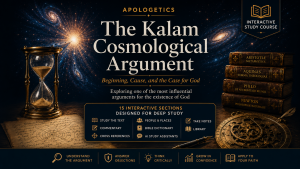
Lesson 3: Kalam Cosmological Argument
Related products
-

-
Sale!
-
Sale!
Lesson 2: Daniel’s Prayer: Repentance, Confession, and Covenant Mercy
Original price was: £12.99.£9.99Current price is: £9.99. -
Sale!
Lesson 3: Kalam Cosmological Argument
Original price was: £12.99.£9.99Current price is: £9.99.



Reviews
There are no reviews yet.