
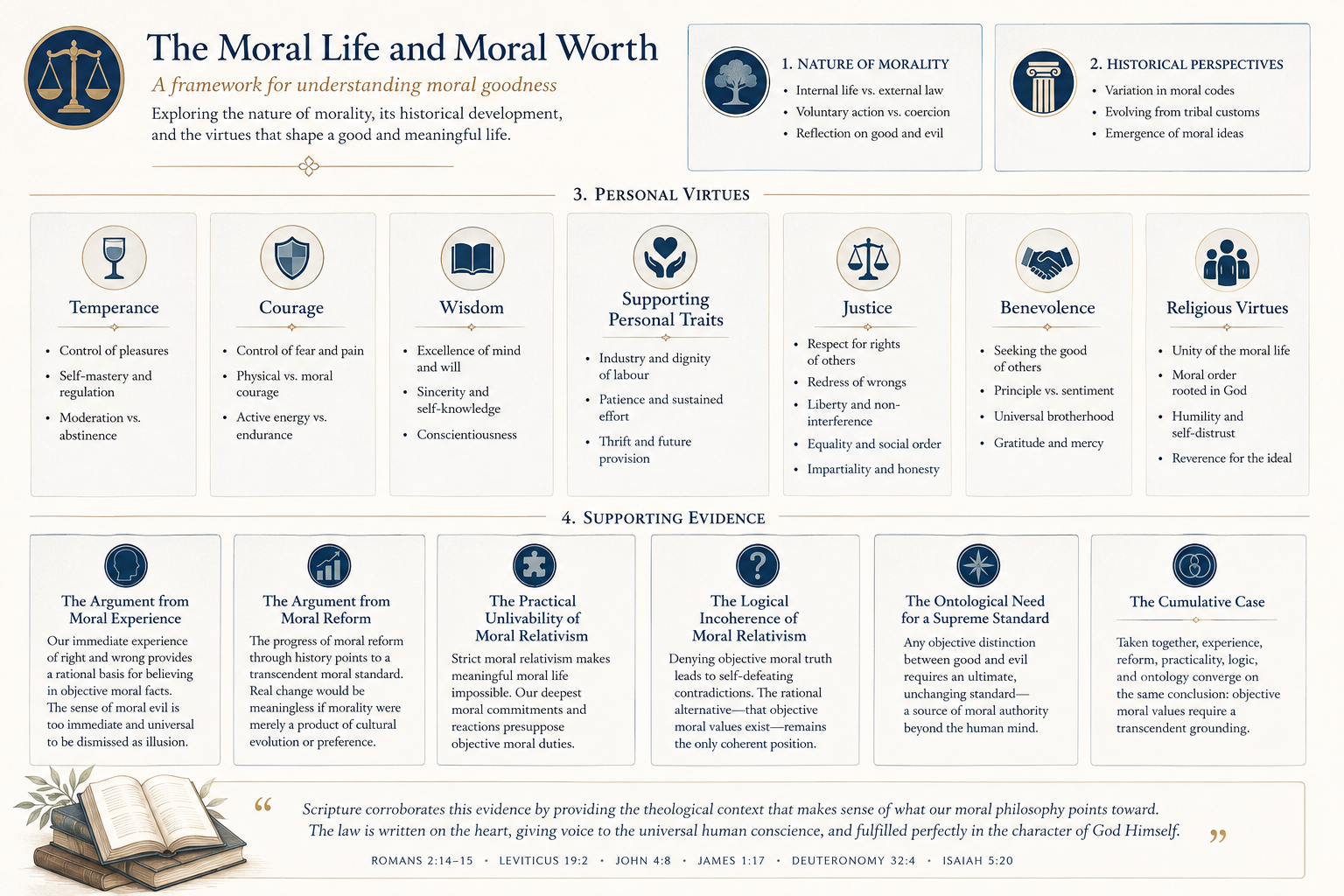
What Actually Makes Someone a Good Person?
We all know the type of person who looks good on paper. They are never late. They pay their bills on time. They recycle properly, return borrowed books, and probably know exactly where their car keys are at all times. Outwardly, everything looks respectable. And yet, sometimes, something still feels missing. That is because goodness is not quite the same thing as rule-keeping. A person can follow the rules and still be selfish, proud, cold, or cowardly. Equally, someone may not have a perfect record and yet have a depth of character that is hard to miss.
That gap between outward behaviour and inward character is not a new problem. In 1911, the philosopher W. R. Sorley wrote about this very thing. His point was simple but searching: morality is not just a rulebook to memorise. It is more like a spirit showing itself in a life. In other words, if you want to understand whether someone is truly good, you cannot only look at what they do. You have to ask what is going on underneath. What are their motives? What do they love? What kind of person are they becoming when nobody is clapping, watching, or threatening punishment?
Sorley called this the “inner circle of personal life”. He gives an interesting example from the anthropologist A. W. Howitt, who once asked a young Aboriginal Australian boy why he would not eat a kind of opossum forbidden to him. There were no elders around to catch him. No one would have known. Yet the boy did not say, “I might get into trouble.” He simply said, “I could not do that; it would not be right.” That is the difference. The rule was not merely hanging over him from the outside. It had become part of his moral world. He was not just avoiding punishment. He had a sense of right and wrong.
So what does it take to build that kind of character? Sorley points us toward several habits and virtues that are still worth thinking about.
Goodness Begins Beneath the Surface
It is tempting to reduce morality to law. Keep the law, behave yourself, avoid scandal, and you are a decent person. That is how many of us instinctively think. Sorley pushes back against that. Laws and customs are external. They change from place to place and from age to age. What is praised in one society may be frowned upon in another. Pascal famously observed that even slight geographical differences, such as “a few degrees of latitude,” can lead to entirely different legal systems and moral norms. In other words, the laws and values upheld in one location may be fundamentally altered merely by crossing into another region.
That does not mean morality is meaningless. It means morality cannot simply be the same as whatever the local rules are. Real morality goes deeper than that. It lives in the “springs of action,” in the motives and desires that exist before anything is done. Two people may do the same outward action for very different reasons. One person may be honest because they love truth. Another may be honest only because they fear being exposed. From the outside, both may look the same. But they are not the same. A genuinely good person is not merely someone who behaves well when the rules are enforced. It is someone whose inner life has been shaped toward what is right.
Temperance Is Bigger Than We Think
When we hear the word “temperance,” we may think immediately of food, drink, or self-control in a fairly narrow sense. Sorley has something much broader in mind. Temperance is about the ordering of desire. That matters because not all desires are bad. Many are perfectly natural. We desire food, comfort, pleasure, friendship, success, rest, beauty, and a thousand other good things. The problem arises when desire stops being a servant and becomes a master.
Sorley pictures the inner life almost like a small kingdom. Our higher nature, the part of us drawn toward truth, meaning, beauty, duty, and love, is meant to govern our lower appetites and impulses. But if appetite takes the throne, the whole kingdom becomes disordered. The highest form of temperance is not just saying no to obviously destructive things. Sometimes it means saying no even to a good thing because something better requires it.
Sorley tells the story of a man who once smoked a cigar so good that he never smoked again. That sounds odd, but the point is not really about cigars. The man recognised the pull that pleasure could have over him, and he chose to remain free. That is a great example of self-discipline. It is not misery for misery’s sake. It is not pretending that pleasure is evil. It is the ability to say, “This is good, but it must not rule me.” That is harder than it sounds.
Work Says Something About Us
We often think of work mainly in terms of income. It pays the bills. It keeps the lights on. It fills the week. If we are fortunate, it may also give us a sense of purpose. Sorley sees work as morally significant. What we do with our time, strength, skill, and attention says something about the kind of people we are. That idea has not always been obvious. Plato and Aristotle both tended to treat manual labour as beneath the life of the ideal citizen. Work was what made leisure possible, and leisure was where the supposedly higher life happened. Someone else did the labour so the philosopher could think.
Sorley challenges that older aristocratic instinct by emphasising the “moral solidarity of mankind.” This concept, that we belong to one another and that ordinary work can be part of our shared moral life, reinforces his broader argument that morality extends beyond mere rule-following to include the deeper connections among people and the character revealed in everyday actions. He contrasts two very different pictures of life. On one side is the aristocratic ideal of someone who contributes little and exists in refined idleness. On the other is someone like Spinoza, who supported himself by grinding lenses while doing serious philosophical work.
The point is not that every job feels noble every moment. Most of us know it does not. Work can be tiring, repetitive, frustrating, and underappreciated. But honest work still matters. It is one of the ways character becomes visible in the ordinary world. The way we work can reveal patience, reliability, humility, diligence, and care for others. Or it can reveal laziness, resentment, pride, and selfishness. A person’s work is rarely just a paycheque. It is often a moral statement, whether we realise it or not.
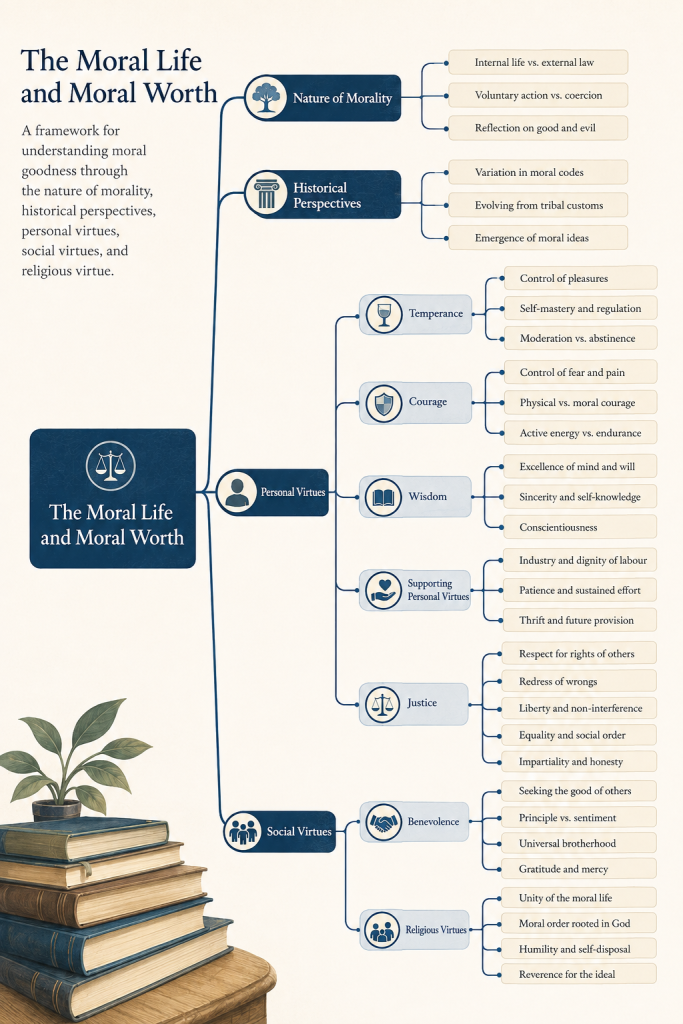
Courage Is More Than a Burst of Adrenaline
We tend to think of courage as a dramatic moment. A sudden danger appears, someone acts bravely, and everyone recognises it at once. There is certainly a kind of courage like that. But Sorley is interested in something steadier and colder. He borrows a phrase from Robert Louis Stevenson’s Catriona: “auld, cauld, dour, deidly courage.” Old, cold, grim, deadly courage. Not the courage of a sudden emotional rush, but the courage that remains when the rush has gone. This is the courage of someone who sees the cost ahead and still chooses what is right. It is the courage to tell the truth when it would be easier to stay silent. The courage to be mocked. The courage to keep going when no one is impressed. The courage to give up comfort for something more important. Sorley suggests that the highest form of courage appears when a person is willing to risk, or even surrender, a genuinely happy life for the sake of something greater than personal comfort.
That is a sobering thought, because many of us are prepared to be brave only as long as the cost is manageable. True courage asks more of us.
Wisdom Starts With Honesty
Wisdom is often confused with intelligence. We imagine the wise person as someone with a large library, a sharp mind, and a head full of facts. Sorley describes wisdom as “virtue of the rational will.” It sounds technical, but the idea is more practical. Wisdom is not only about what you know. It is about whether you can see clearly, choose rightly, and be honest about your own motives. Sorley speaks of “veracity to sentiment,” which means being truthful about what is really going on inside you. Why do you want what you want? Why did that comment annoy you so much? Why are you drawn to that particular ambition? Why are you avoiding that particular duty?
Wisdom is the virtue of the rational will. It implies not merely the knowledge of what is good, but the steady direction of the will towards it. And its first condition is that inward truthfulness, veracity to sentiment, which prevents a man from deceiving himself as to his own motives.
William R Sorely – The Moral Life and Moral Worth
We are very good at telling ourselves noble stories about our motives. We say we are being principled when we are actually being stubborn. We say we are being cautious when we are really afraid. We say we are being honest when we are merely enjoying the chance to be harsh. Wisdom begins when we stop lying to ourselves. It is a mirror before it is a library. The wise person is not necessarily the one who can quote the most books. It is the one whose inner life and outward actions are being brought into alignment with truth.
Thrift Can Become a Trap
Thrift usually sounds like an obvious virtue. Save money. Avoid waste. Live sensibly. Do not spend what you do not have. Fair enough. Sorley does not dismiss thrift, but he warns that it is a “two-edged sword.” Used well, thrift can give a person freedom. It can protect a family from unnecessary hardship. It can make generosity possible. It can help someone live with dignity rather than being ruled by every passing appetite.
But thrift can also go sour. It can become fear dressed up as wisdom. It can harden into meanness. It can make a person suspicious, ungenerous, and unwilling to help because every need looks like a threat to their savings. The question is not simply, “Are you saving?” The better question is, “What is your saving doing to your soul?” Are you becoming freer, steadier, and more able to serve others? Or are you becoming smaller, colder, and more tightly clenched? Sorley warns that the wrong kind of thrift can “breed meanness in your inmost soul.” That is painfully direct, but he is right. Money is never just money. The way we handle it shapes us.
Becoming Whole
Ultimately, Sorley’s conception of goodness moves beyond merely accumulating individual virtues as if assembling items on a checklist. Instead, he challenges us to consider a more fundamental issue: is one’s life moving toward genuine integration and moral wholeness?
There is always a relationship between the inner life and the outer life, between the self and the society around us. Sorley compares this to the two foci of an ellipse. Everything we do is shaped by both. We are individuals, but we do not live in isolation. Our choices affect other people, and other people’s needs make claims on us. A good person is not someone who escapes the world into private moral perfection. Nor is goodness simply being useful to society while inwardly empty or corrupt. True character holds the two together. The inner life matters. The shared life matters. The question is whether they are pulling in the same direction.
That kind of character is not built overnight. It is formed slowly, through repeated choices. It grows when our desires are disciplined, our motives examined, our work done faithfully, our courage tested, our money handled wisely, and our lives opened outward toward others.
So perhaps the question is not simply, “Am I following the rules?” A better question might be: “What kind of person am I becoming?”
That is where the moral life really begins.
