
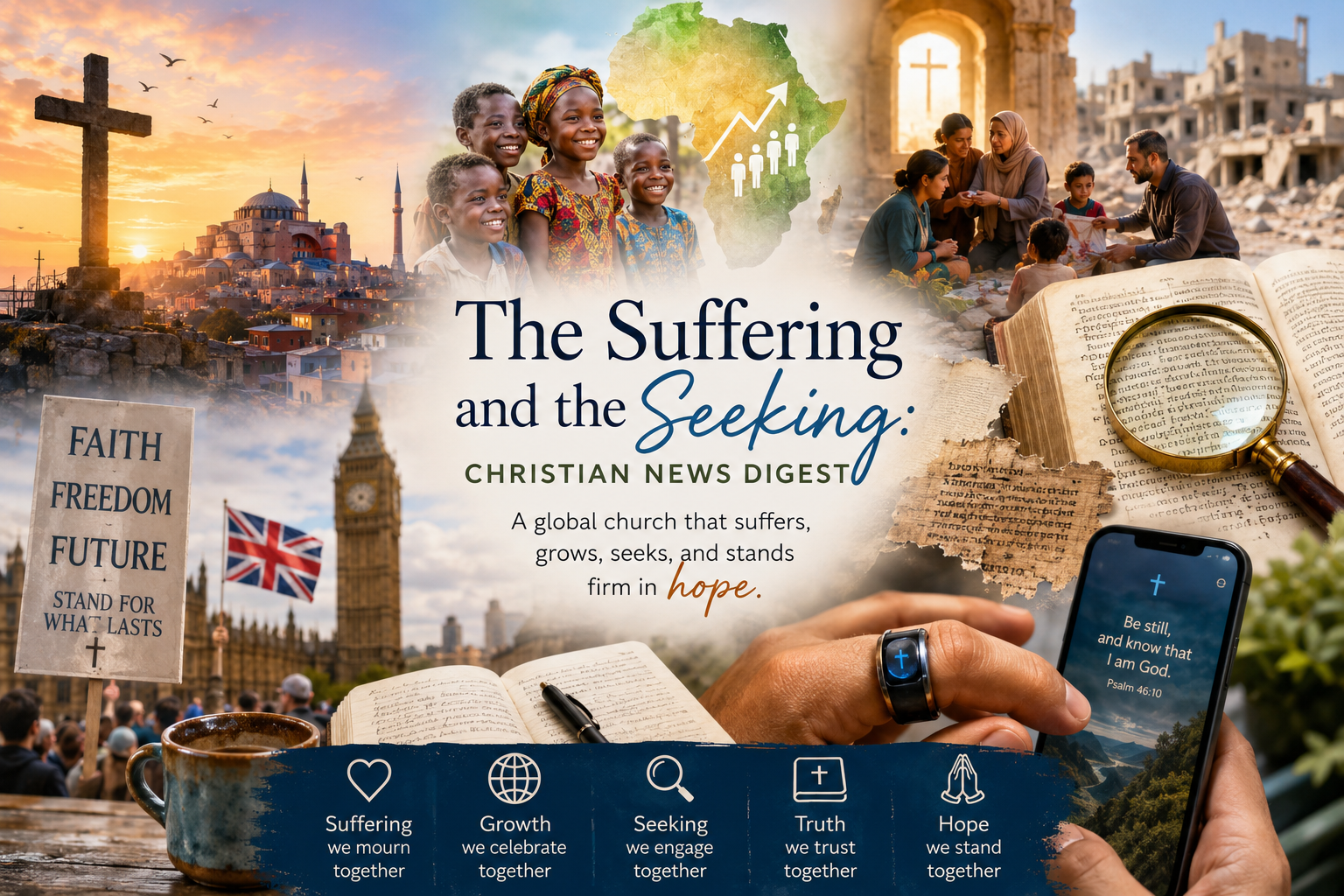
This week’s news brief draws our attention to the Church in both sorrow and strength. We remember the fall of Constantinople in 1453, a sobering moment of loss in Christian history, while also looking at the suffering of believers in places such as Nigeria and Syria today. Yet alongside these stories of hardship, we also see signs of endurance and hope: the growing influence of the African church, renewed questions about Britain’s Christian heritage, fresh discoveries that shed light on the transmission of Scripture, and new technologies that raise important questions about discipleship in the digital age. Together, these stories remind us that the Church continues to suffer, grow, seek, and stand firm, held not by the strength of human institutions, but by the faithfulness of God.
Constantinople fell
On 29 May 1453, Constantinople fell to the Ottoman Empire after more than a thousand years as one of the great centres of Eastern Christianity. Its fall marked the end of the Byzantine Empire and was felt by many Christians as a devastating loss: a city filled with churches, theological history, and imperial Christian memory passed into a new era. We remember it not simply as a political or military event, but as a reminder that earthly centres of Christian power can rise and fall, while the Church itself endures by the faithfulness of God. It invites us to pray for believers facing upheaval today, and to place our hope not in monuments, empires, or institutions, but in Christ, who remains Lord over history.
A Heavy Toll: The Persecuted Church in Nigeria and Syria
The weight of suffering for the global church remains centred in Nigeria, which now accounts for a staggering 72 per cent of Christian killings worldwide. Recent coordinated attacks over the Easter season in central Nigeria claimed dozens of lives, continuing a pattern of relentless violence against believers. The sheer scale of the persecution has prompted calls from international observers for sanctions, but for our brothers and sisters on the ground, the danger is a daily reality.
Meanwhile, the political upheaval in Syria has created a new climate of uncertainty for its ancient Christian communities. The nation has jumped to number six on the Open Doors World Watch List, as believers navigate life under a new government that has yet to guarantee religious freedom. In traumatised cities like Aleppo, local churches are courageously stepping into the breach, providing counselling, aid, and discipleship training to a people clinging to faith amid the rubble.
For Reflection: The Apostle Paul writes that “if one member suffers, all suffer together” (1 Cor. 12:26). How can our small groups and churches move beyond awareness to actively bear the burdens of our persecuted family in prayer, advocacy, and support?
The Heartbeat of the Global Church: Africa’s Growing Influence
While parts of the world face deep uncertainty, a story of incredible growth continues to unfold in Africa. A new analysis from the Pew Research Centre projects that by the year 2100, the continent will be home to nearly half of the world’s young people. This demographic reality has profound implications for the global church, cementing Africa’s role as the driving force of world Christianity for generations to come.
This shift is already reshaping the landscape of global missions. The Lausanne Movement, for instance, is hosting its first Workplace Forum for Africa and the Middle East, recognising that the continent’s leaders are primary agents, not just recipients, of the Great Commission. The future of theological formation, worship, and evangelism will be increasingly shaped by the vibrant faith of our African brothers and sisters.
For Reflection: As the centre of gravity in Christianity shifts south and east, what postures of humility and learning must the Western church adopt? How can we faithfully partner with and learn from the Majority World church?
UK: Kemi Badenoch and the “Christian Nation” Debate
One of the more thought-provoking stories from the UK this week involves Conservative leader Kemi Badenoch. She has publicly declared she will “fight for” Christian values in society, despite describing herself as an agnostic who has lost personal belief in God. Speaking to Piers Morgan, she called herself a “cultural Christian,” saying: “This is a Christian country. I don’t want to see Christianity disappear… overall I think that Christianity is a force for good.” Her support for Britain’s Christian heritage comes alongside a pledge to restore funding for the Listed Places of Worship Grant Scheme, which helped historic churches with repair costs. Support for Christian heritage has become a talking point across right-leaning parties, though all are led by figures with minimal personal Christian commitment. Premier Christianity has raised the uncomfortable question of whether preserving buildings is a substitute for preserving faith itself. Religion Media Centre, Christian Today
For Reflection: What does it mean for a society when its political leaders defend Christianity as a cultural value but not a personal one? How should the church engage with this kind of “cultural Christianity”?
Ancient Words Uncovered: New Light on the New Testament
In a thrilling development for anyone who loves Scripture, researchers have recovered 42 lost pages of a sixth-century manuscript of Paul’s letters. The pages of Codex H were disassembled centuries ago at a monastery on Mount Athos and reused in the bindings of other books. Using advanced imaging technology, scholars were able to read the “ghost text” of the original Pauline epistles, giving us a clearer window into how the New Testament was copied and circulated in the early church.
This discovery comes alongside news that another fragment of the Dead Sea Scrolls has been decoded, adding more detail to our understanding of the Jewish world into which Jesus was born. These finds are not just academic curiosities. They are tangible reminders of God’s remarkable providence in preserving His Word through the ages, confirming the deep historical roots of the faith we profess.
For Reflection: In an age of scepticism, how can discoveries like these bolster our confidence in the reliability of Scripture and enrich our own study of the Bible?
Algorithm and Altar: Technology and the Spiritual Life
What is the proper role of technology in our walk with God? That question is becoming more urgent with the launch of the world’s first “Christian smart ring.” The device biometrically monitors a user’s emotional state and then delivers AI-curated Scripture verses in response. The creators hope it will be a tool for spiritual encouragement and mindfulness.
This innovation raises important questions for discipleship. While technology can be a wonderful aid, we must also ask if it can displace the slower, more disciplined work of prayerful Scripture reading and meditation. Does an algorithm that serves up a comforting verse based on our heart rate deepen our relationship with God, or does it risk turning Scripture into a mere therapeutic tool? The conversation is a vital one as we seek to follow Christ faithfully in an ever-changing digital world.
For Reflection: Where is the line between using technology as a helpful tool for spiritual growth and allowing it to become a substitute for the unmediated work of the Holy Spirit in our lives? Discuss where you see both promise and peril.
summary
From the sorrows of Nigeria to the demographic hope of Africa, from ancient manuscripts to modern gadgets, God’s hand is moving. He is sustaining His persecuted church, growing His global family, preserving His timeless Word, and calling us to walk with wisdom in our complex world. May we continue to watch, pray, and serve Him faithfully until He comes again.