
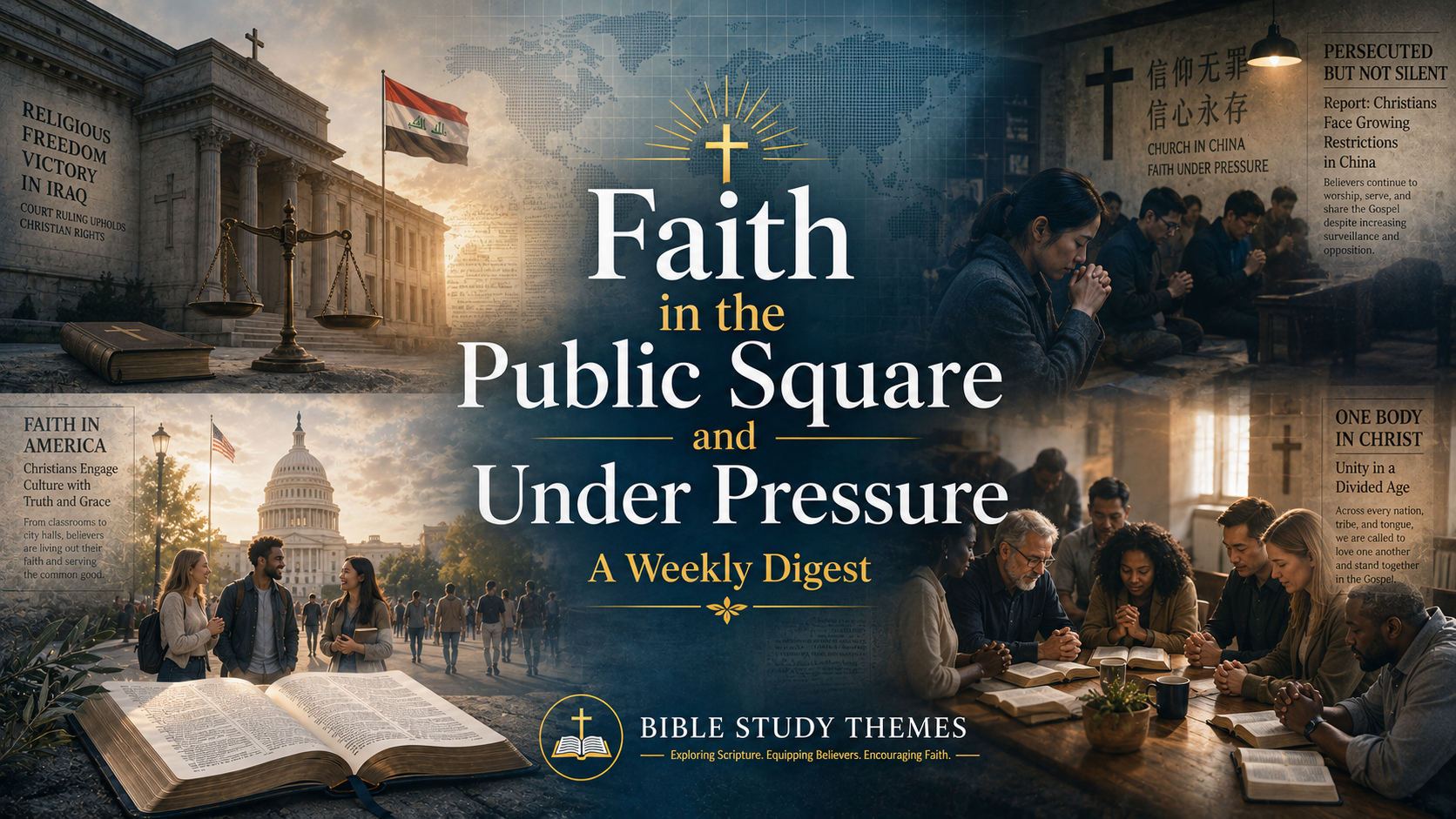
What does it mean for faith to have a public voice? This week’s news brings that question to the forefront, showing us a church caught between public witness, legal pressure, political tension, and costly faithfulness, even as it celebrates a quiet, courageous victory for identity in a courtroom overseas. It is a powerful reminder that our faith is at once a deeply personal conviction held at great cost and a public witness that shapes the world around us.
A Landmark Victory for Religious Identity in Iraq
In a remarkable piece of news from the Middle East, an Iraqi court has ruled in favour of Maryam, a young Christian woman who was legally designated as a Muslim. Under Iraqi law, a child is automatically registered as Muslim if one parent converts to Islam. This happened to Maryam when her mother remarried a Muslim man, stripping her of her Christian identity in the state’s official records.
On May 12, a court in Duhok restored her Christian status, a decision that could set a powerful precedent for dozens of other Christians facing similar situations. While the state is expected to appeal the ruling, this victory is a significant moment of hope for religious freedom in Iraq. It affirms that a person’s deeply held faith cannot be simply erased by a legal statute, and that identity in Christ is worth fighting for, both in our hearts and in the courts.
For reflection: Maryam’s story highlights the tension between a state-imposed identity and a spiritual one. How does this challenge us to consider the security we have in our identity in Christ, which no earthly power can ultimately define or take away (Galatians 3:26-28)?
Prayer, Polls, and the Place of Faith in America
In the United States, the conversation around faith’s public role took centre stage. On Sunday, thousands gathered on the National Mall for “Rededicate 250,” a prayer rally organised ahead of America’s 250th anniversary. With high-profile political leaders in attendance, the event was intended as an act of national spiritual rededication, though it also drew criticism for blurring the lines between church and state.
At the same time, a major new study from the Pew Research Center revealed a complex American perspective on religion. A majority of Americans, 55 percent, now view religion’s influence on society positively, the highest that figure has been in over two decades. Yet, the same study found that 52 percent believe conservative Christians have gone too far in trying to impose their values through government and public schools. Americans seem to want the fruit of religious belief in society, but they are wary of its political expression.
For reflection: These events reveal a deep tension in our culture. How can the church offer a faithful public witness in a way that is both prophetic and persuasive? Where do we draw the line between seeking the good of our nation and becoming entangled with partisan power?
The “Unite the Kingdom” March
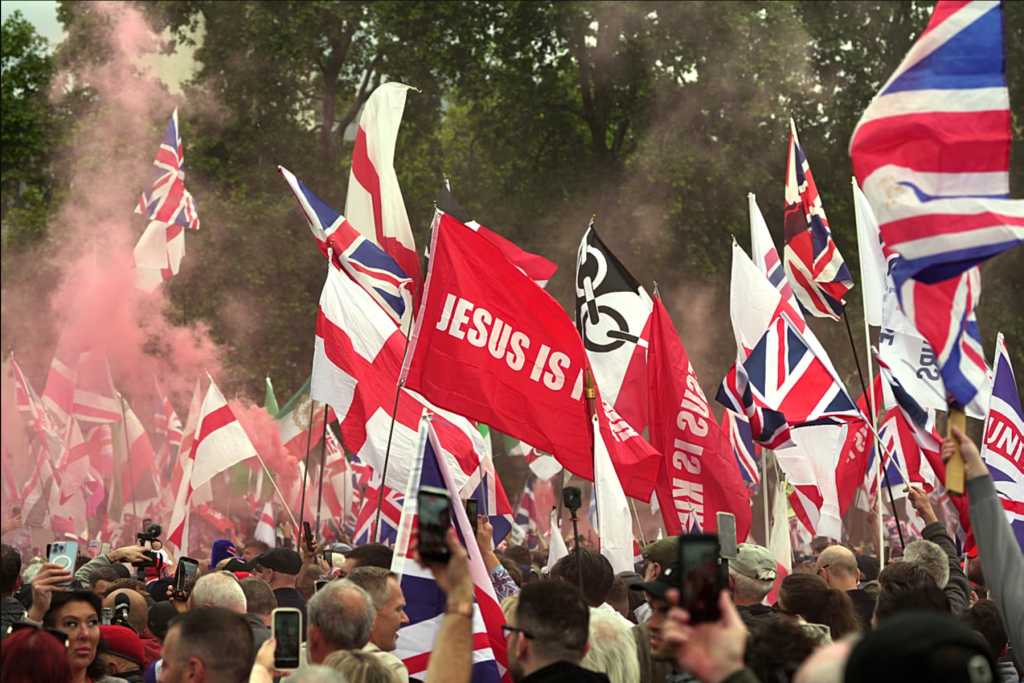
Last weekend, London became the focus of two very different demonstrations. The “Unite the Kingdom” march drew around 60,000 people according to police estimates, while a separate Nakba Day rally also took place nearby, with organisers claiming much larger numbers than the police estimate. With so many people gathering around such emotionally charged issues, there was a major police operation to keep the routes separate and avoid serious trouble.
But the part that caught some attention wasn’t really the noise of the protests. It was what happened in the quieter spaces nearby.
A number of Christian groups, including Red Letter Christians, Better Story, and Christians Against the Far Right, set up “listening stations” along the route. Their aim wasn’t to argue, shout people down, or try to win a political debate on the pavement. They were simply there to listen.
The Bishop of Edmonton, Dr Anderson Jeremiah, spent time at the tables and said that many people who join these marches are carrying a deep sense that they are not being heard. Whether we agree with them or not, that is something the Church probably needs to pay attention to. Baptist minister Revd Sally Mann described the volunteers as “peace envoys”, choosing the way of Jesus — love, welcome, and presence — rather than fear and division.
That does not mean Christians should be naïve. Some of the language and symbolism around nationalist movements can be deeply troubling, especially when Christian words or images are used in ways that have very little to do with Christ. But it also means we need to be careful not to dismiss every person in the crowd as though they are all the same. People are complicated. Some are angry. Some are afraid. Some are genuinely confused about what is happening in the country. Some may be carrying prejudice. Some may simply feel ignored.
A new poll from Theos added another layer to this. It suggested that explicitly Christian nationalist beliefs are still a minority view in the UK, with only 17% agreeing that someone must be Christian to be truly British. But the fact that Christian language can be pulled into these debates should make us stop and think.
For reflection: For me, the challenge is this: how does the Church stay present in public life without becoming just another political tribe? How do we speak clearly where things are wrong, but still listen well enough to understand what people are really carrying? Jesus did not avoid tense places. But He also did not let the crowd set His agenda. That feels like something worth remembering.
The Enduring Witness of China’s House Churches
As we consider the complexities of religious freedom in the West, it is vital to remember our brothers and sisters for whom faith comes at a much higher price. In China, house church members Chang Yuchun and his wife, Li Chenhui, remain detained in separate prisons as part of an ongoing and severe crackdown on unregistered Christian communities. Their story is just one among many in what observers call the worst period of religious suppression in China since the Cultural Revolution.
The government continues to pressure both Protestant house churches and underground Catholic communities to register with state-controlled religious bodies. This is a systematic effort to bring the church under the authority of the Communist Party. For believers like Chang and Li, the simple act of gathering for worship outside of state control is treated as a crime, a stark contrast to the freedoms often taken for granted elsewhere.
For reflection: Hebrews 13:3 calls us to remember those in prison as though we were with them. How can we pray more faithfully for believers like Chang and Li, and allow their costly faithfulness to challenge the way we use our own freedom?
final thought
From a courtroom in Iraq to the streets of London, the church is seen this week in its beautiful and complex reality. It is a body that fights for justice, speaks into culture, suffers with quiet faithfulness, and strives for unity. May these stories move us to pray with greater wisdom, to love our neighbours with greater compassion, and to hold fast to the hope we have in our sovereign God, who is building His church and against whom the gates of hell will not prevail.