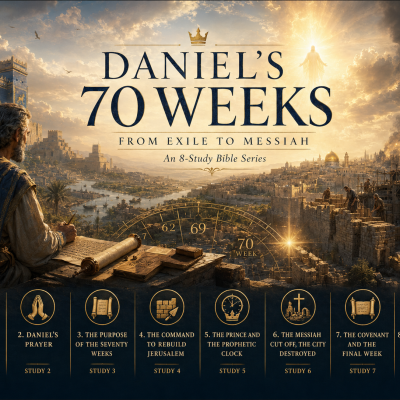
If you have ever waded into the prophetic waters of the Old Testament, you know that few passages are as captivating, or as intensely debated, as Daniel 9. As a biblical researcher, I often find myself marvelling at this specific chapter. It is a masterpiece of apocalyptic prophecy that transitions from a deeply personal, pastoral prayer into a cosmic timeline of redemption.
This post embarks on a scholarly journey through Daniel’s “Seventy Weeks.” Rather than getting lost in the weeds of date-setting, our goal is to explore the distinct interpretive schools of thought that have engaged with this text for centuries. We will isolate the core textual, historical, and linguistic mechanics that drive these fascinating debates. Let’s dive in!
The Catalyst of Prayer and the Pronoun “We”
Our story begins with a study session. Daniel is reading the scrolls (sepharim) of the prophet Jeremiah and realises that the prophesied seventy years of Babylonian exile are drawing to a close. This discovery drives him to his knees in repentant intercession. Immediately, scholars face their first theological tension: the relationship between divine sovereignty and human responsibility. Does Daniel’s prayer fulfil a necessary condition for God’s promise to come true, or is his prayer simply aligning with an already guaranteed sovereign plan?
This brings us to a fascinating linguistic mechanic in Daniel’s prayer: the use of the pronoun “we”. When Daniel confesses the sins of Israel, commentators debate whether we should read this as the “Confession of a Sinner” or the “Confession of a Representative.” Some scholars argue that Daniel is acknowledging his own genuine, personal sinfulness as a member of a fallen humanity. Others point out that Daniel is consistently portrayed as uniquely righteous in Scripture; therefore, his use of “we” functions in a formal, priestly capacity, legally identifying with his people’s rebellion much like a lawyer representing a client.
Framing the Prophetic Clock: The Sixty-Nine Weeks
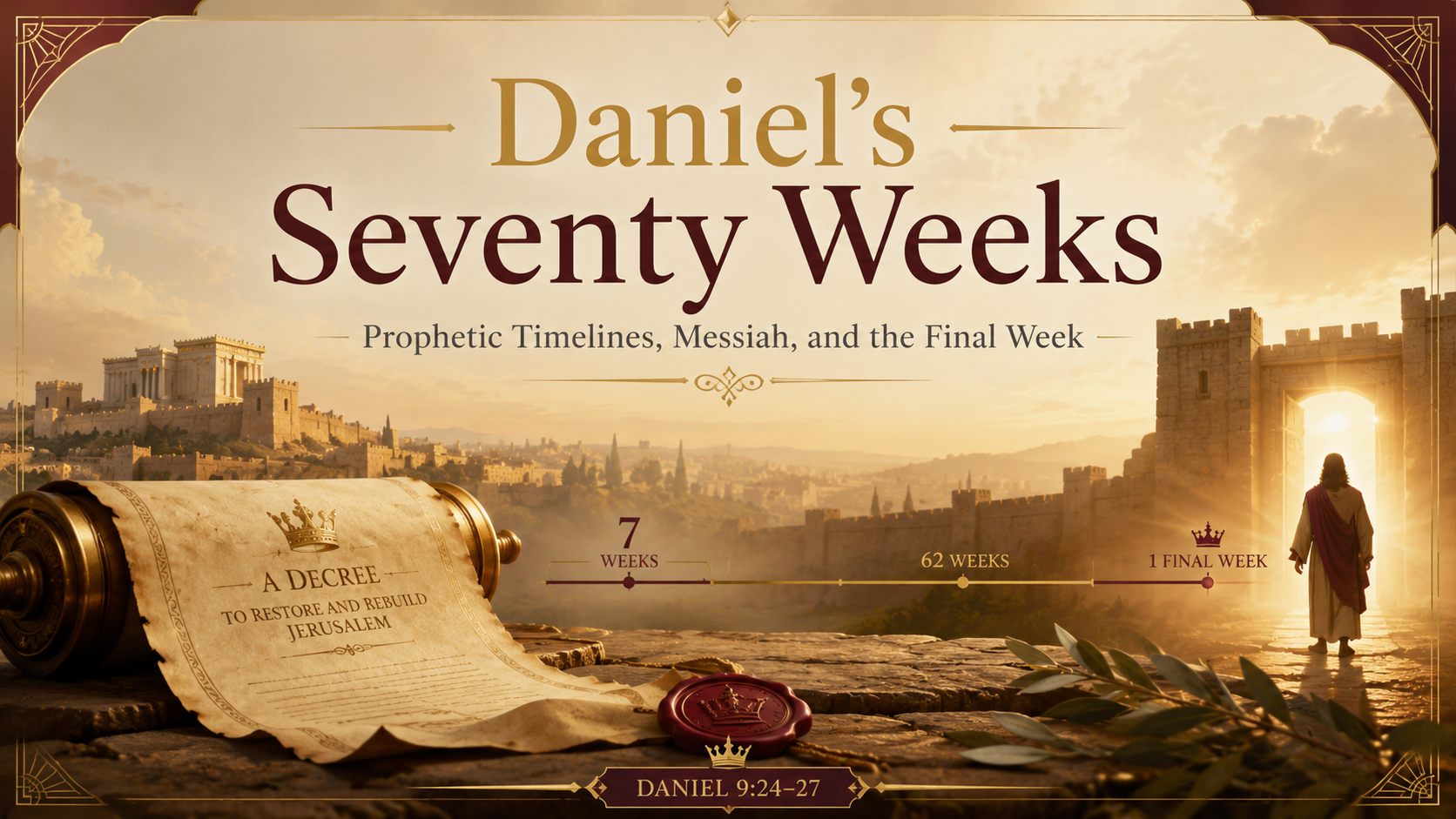
While Daniel is praying about seventy years, the angel Gabriel arrives to reframe his perspective around seventy sevens (the Hebrew word shavuim, meaning weeks or sevens of years, totaling 490 years). Gabriel outlines a six-fold purpose for this timeline: to finish transgression, put an end to sin, atone for iniquity, bring in everlasting righteousness, seal up vision and prophecy, and anoint the most holy.
Here, a massive debate emerges regarding the fulfillment of these six goals. Are they “Finished” or “Future”?
- The Finished Work: Many theologians, including the early Reformers, argue that Jesus decisively fulfilled all six goals during His first advent through His death and resurrection.
- Two-Stage Fulfillment: Conversely, many modern dispensational scholars argue that while Christ provided the basis for atonement, the full, cosmic eradication of sin and the establishment of everlasting righteousness await His Second Coming.
To understand when this prophetic clock starts, we have to isolate the Hebrew word dabar (meaning word, command, or decree). Gabriel states that the clock begins with the “going forth of the word to restore and build Jerusalem”. But which historical decree is this?
- The Earlier Decree (Cyrus, 538 BC): Some scholars look to King Cyrus, emphasizing the spiritual restoration of the temple.
- The Later Decree (Artaxerxes, 457 or 444 BC): Others insist the clock starts later with Artaxerxes, because the text explicitly mentions rebuilding the city’s “street” and “wall”—a sign of civic and defensive autonomy, not just temple worship.
Furthermore, scholars debate whether we should calculate this timeline with exact mathematical precision (using 360-day prophetic years to land precisely on the day of Jesus’s Triumphal Entry) or view the numbers as theological symbols representing a divine, perfectly ordered era.
The Messiah Cut Off and the Coming Prince
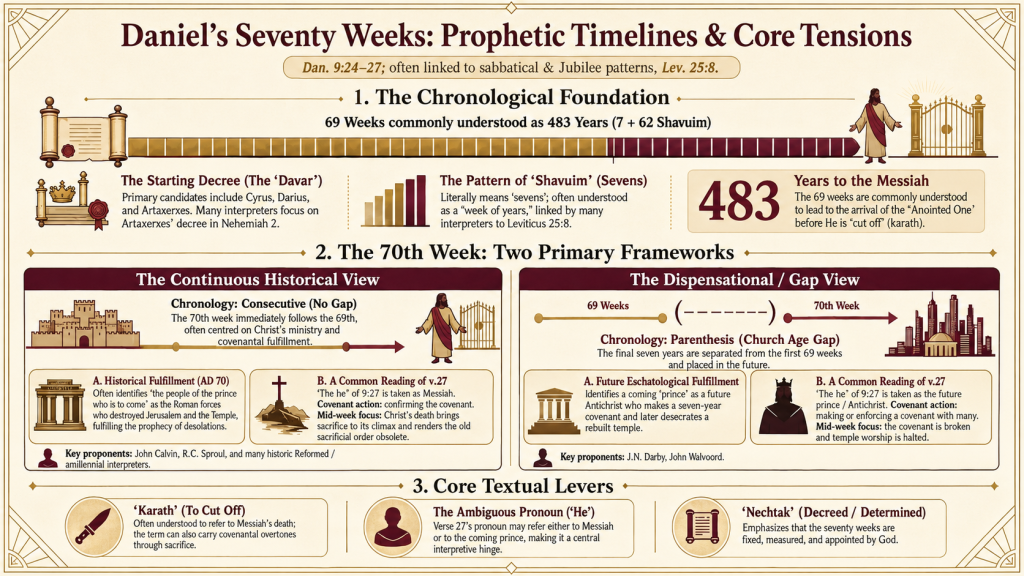
As the timeline progresses to the end of the sixty-ninth week, the text delivers a shocking revelation: the Messiah will be “cut off”. The Hebrew verb used here is karath, a violent term meaning to sever or eliminate, often associated with a judicial execution or the cutting of a covenant sacrifice. This shatters any expectation of a purely conquering, earthly king.
Following the cutting off of the Anointed One, Daniel 9:26b states that “the people of the prince who is to come shall destroy the city and the sanctuary”. The historical and grammatical hinge here is identifying this “prince.”
- The Roman General Titus: Many scholars see a direct historical fulfillment in AD 70. The “people” are the Roman armies, and the “prince” is Titus, who physically burned the temple and destroyed Jerusalem, permanently ending the sacrificial system.
- The Future Antichrist: Other interpreters argue that this prince is a future, eschatological Antichrist who will emerge from a revived form of the Roman empire, placing the ultimate fulfillment of this destruction at the end of history.
The Final Week and the Abomination of Desolation
The debates reach their peak in Daniel 9:27, which describes a final “week” (seven years) where a figure “shall confirm a covenant with many” and put a stop to sacrifices, leading to an “abomination of desolation”. The entire interpretive framework hangs on a single grammatical antecedent: Who is the “he” in verse 27?
- The Messiah’s Covenant: If the “he” refers back to “Messiah the Prince,” then this final week describes Jesus. In this view, Christ’s death on the cross definitively “confirmed the covenant” (the New Covenant) and put a permanent, theological end to the need for animal sacrifices.
- The Antichrist’s Treaty: If the “he” refers back to “the prince who is to come,” then the covenant is a deceptive political peace treaty made by a future Antichrist with Israel, which he breaks at the three-and-a-half-year mark by outlawing worship.
This brings us to the infamous “abomination of desolation” (the Hebrew shiqqutsim, a technical term for extreme idolatry). When Jesus references this exact phrase in Matthew 24:15, He commands the reader to understand. But what is the sign? Some scholars, leaning on historical precursors like Antiochus Epiphanes, argue it will be a specific, literal idol or a false god erected in a rebuilt future temple. Conversely, others look to Luke 21:20 (“when you see Jerusalem surrounded by armies”) and argue that the abomination was the desecrating presence of the pagan Roman army destroying the holy space in AD 70.
Finding Certainty in the Mystery
As we wrap up our study, it is perfectly fine if your head is spinning just a little bit! These verses are among the most densely packed and debated in all of Scripture. From the translation of dabar and karath, to the grammatical antecedents of pronouns, brilliant minds have landed on different sides of these historical and theological divides.
Yet, beneath the mechanics of the debate, a beautiful and unifying truth emerges. Whether the timeline is a mathematical puzzle or a symbolic tapestry, and whether the final conflict is entirely past or still awaiting a future consummation, the ultimate hero of Daniel 9 is unmistakably Jesus Christ. This prophecy stands as a magnificent testament to God’s sovereign control over human history, assuring us that He deals decisively with sin and always fulfills His promises right on time.
Thank you for joining me in this deep dive! Keep studying, keep asking questions, and always read with an open, awe-filled heart.