

David wants to build a temple
Most of us know what it feels like to want to do something meaningful for God. We want our lives to count. We want to build something that lasts. We want to serve well, lead well, give well, and leave behind some kind of faithful legacy. And those desires are not wrong in themselves. But if we are not careful, even good desires can quietly become a way of proving ourselves. We can start to believe that our value before God depends on what we achieve for Him.
King David faced something like this. Around 1000 BC, David was at the height of his reign. His enemies had been subdued, his kingdom was secure, and he was living in a beautiful palace made of cedar. But something bothered him. While David lived in comfort, the Ark of God remained in a tent. To David, this did not feel right. He wanted to build a permanent temple for the Lord. It sounded noble, generous, and deeply spiritual. But in 2 Samuel 7:11-16, God gave David an unexpected answer. God said no.
Not because David’s desire was evil. Not because David did not love Him. But because God wanted to teach David, and us, something far deeper about success. David wanted to build a house for God, but God said, “The LORD will make you a house” (2 Samuel 7:11). That one sentence turns everything around. David came to God with a plan. God answered with a promise. David wanted to give God a building. God promised David a lasting family line. David was thinking about what he could do for God. God shifted the focus to what He would do for David. That is grace, and it is still the lesson many of us need today.
When God Redefines “House”
One of the beautiful things happening in this passage is a play on the Hebrew word bayit, which means “house.” David was thinking of a physical house, a temple made of stone, cedar, and gold. But God used the same word in a much bigger way. He promised David a “house” in the sense of a dynasty, a family line, and a lasting kingdom. David wanted to build something visible. God wanted to build something eternal.
A temple could be damaged. A palace could fall. A city could be conquered. But God’s promise would continue far beyond David’s lifetime. This is where the passage becomes so personal for us. We often think success means building something people can see. A ministry. A reputation. A platform. A family legacy. A list of achievements we can point to and say, “Look what I did for God.” But God is not nearly as impressed by our building projects as we are. He is far more interested in forming us, shaping us, and anchoring us in His grace.
David’s dream was not wrong, but it was too small. He wanted to build God a temple. God wanted to give David a promise that would reach all the way to Christ. The promise God gave David is often called the Davidic Covenant, and it was not a reward David earned. It was not God saying, “You have performed well enough, so now I will bless you.” It was a gift. Again and again in this passage, God says, “I will.” The weight of the promise rests on God’s faithfulness, not David’s performance.
Discipline Without Abandonment
That matters because David’s family line would not be perfect. Far from it. There would be sin, failure, rebellion, and heartbreak. Yet God’s promise would not collapse under human weakness. This is where the story becomes incredibly comforting. God’s plans are not as fragile as we sometimes fear. We may stumble. We may misunderstand what God is doing. We may even chase the wrong version of success for a while. But God remains faithful. He knows how to redirect us without abandoning us.
In verse 14, God says that when David’s descendants sin, He will discipline them. There will be consequences. God does not pretend sin does not matter. But then comes the mercy. God promises that His steadfast love will not depart from David’s line in the way it departed from Saul. This is such an important part of the passage. God’s covenant with David includes both discipline and commitment. He will correct, but He will not abandon. He will rebuke, but He will not walk away from His promise.
Many of us struggle to hold these two truths together. We either imagine God as harsh and ready to reject us, or we imagine Him as so soft that our choices do not matter. But Scripture gives us something better. God is holy, and God is faithful. He disciplines His people, but He does not discard them. That would become a major theme in David’s family line. The kings who followed David often failed badly. Some led the people into idolatry. Some ignored God’s law. Eventually, the kingdom itself fell. But even then, God’s promise was not dead.
A Promise That Outlasted the Throne
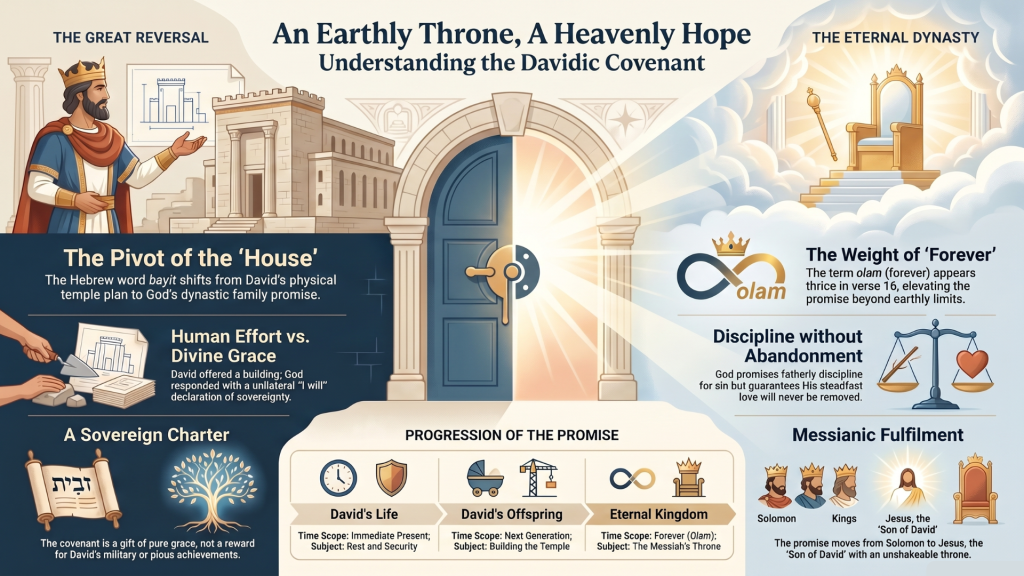
The high point of God’s promise comes in verse 16: “And your house and your kingdom shall be made sure forever before me. Your throne shall be established forever” (2 Samuel 7:16). The word “forever” is the heartbeat of this promise. And yet, from a human point of view, it must have looked like that promise failed.
In 586 BC, Jerusalem fell. The temple was destroyed. The monarchy came to an end. David’s throne seemed empty. The visible signs of the promise were in ruins. You can almost feel the pain behind Psalm 89, where the psalmist wrestles with this very question: God, what happened to Your promise? It is the kind of question we still ask in our own way. God, I thought You were leading me here. God, I thought this door would open. God, I thought this dream was from You. God, why does it look like everything has fallen apart?
But the fall of Jerusalem was not the end of God’s promise. It was part of the long road toward its fulfilment. The promise to David was always bigger than an earthly throne. It was pointing forward to Jesus, the Son of David, the true King who fulfils this promise. He does what no other king in David’s line could do. He reigns with perfect righteousness. He conquers sin and death. He builds a kingdom that cannot be destroyed.
From David’s Throne to Christ’s Kingdom
Jesus builds a house too, but not a temple made of stone. He builds a people who belong to God. This means David’s story does not end with disappointment. It ends with Christ. The temple David wanted to build was only a shadow of something greater. Through Jesus, God would dwell with His people in a deeper and more lasting way.
That brings us back to the ambition trap. David wanted to do something great for God, but God showed David that the greatest thing was not what David could build. It was what God had promised to build through him. And the same is true for us. Our lives are not measured by how impressive our achievements look. They are not measured by whether we build something big, visible, or applauded by others. Real success is receiving God’s grace and trusting His work.
It is being faithful with what He gives us, while remembering that the kingdom does not depend on our strength. It is letting God shape us, even when He says no to something we deeply wanted. God’s “no” to David was not a rejection of David’s heart. It was an invitation into something better. That can be hard to believe when we are the ones hearing no. A closed door can feel like failure. A delayed dream can feel like punishment. A quiet season can feel like we are being overlooked. But David’s story reminds us that God’s grace is often doing more than we can see.
Sometimes God says no to the thing we want to build because He is building something deeper in us. Sometimes He takes away the need to prove ourselves so we can learn to rest in His promise. David did not need to secure his legacy. God had already promised to do that. And in Christ, we do not need to secure ours either. Our worth is not found in what we achieve for God. It is found in the God who has come near to us, made promises to us, and brought us into His eternal house through Jesus.
The truest success is not building our own name. It is resting in the name, promise, and kingdom of Christ.